
10 Best Crypto Exchanges for Day Trading (2026 Fee Comparison)
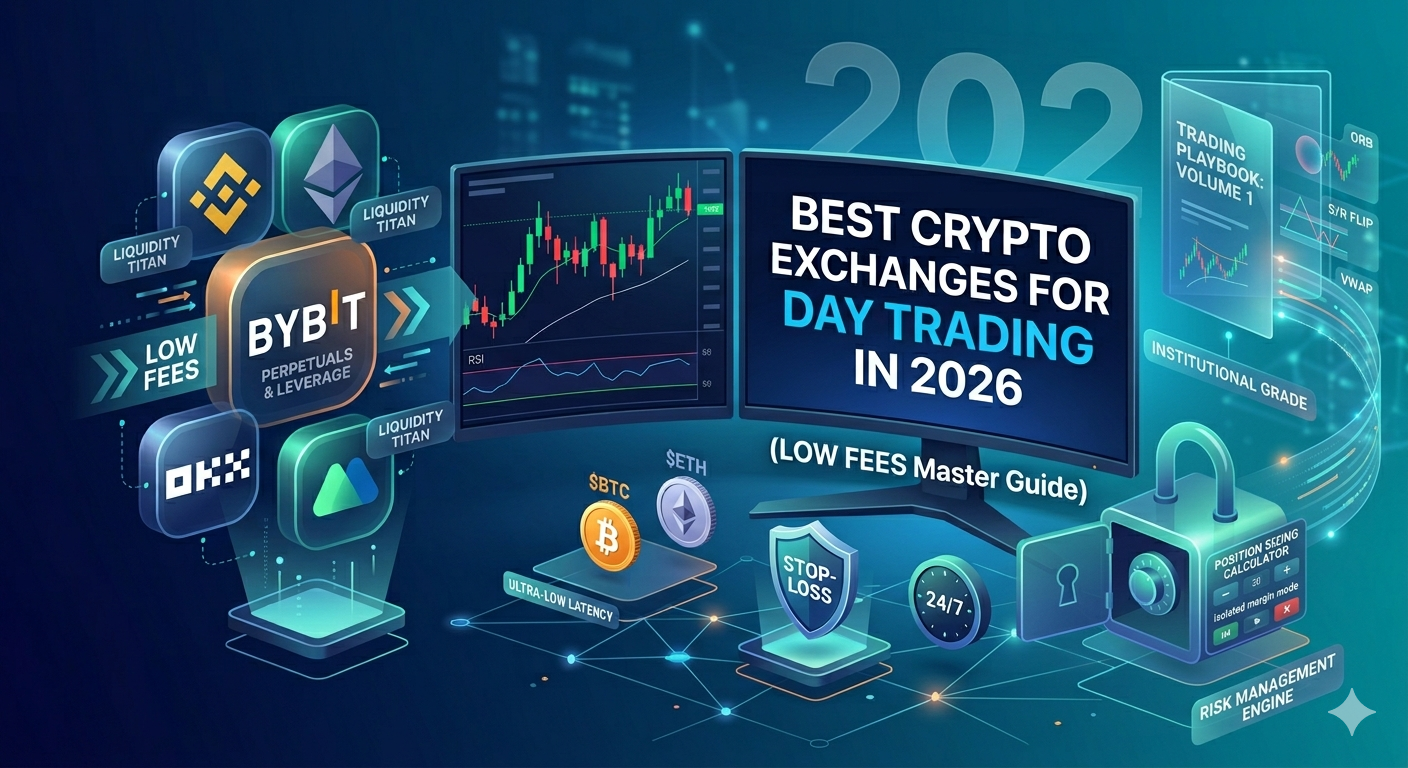
Las mejores plataformas de intercambio de criptomonedas para operar intradía en 2026 (comisiones bajas)
El mercado de las criptomonedas cambia a un ritmo vertiginoso. A medida que avanzamos hacia 2026, el panorama de la ejecución de activos digitales ha experimentado una transformación radical, pasando de la simple casación de órdenes al contado a arquitecturas de derivados altamente complejas y de latencia ultrabaja. Para los participantes activos del mercado, elegir entre la gran cantidad de plataformas de negociación de criptomonedas disponibles es la decisión más crucial que determina la rentabilidad básica.
El trading intradía se basa en aprovechar pequeñas fluctuaciones de precios durante horas, minutos o incluso segundos. En un entorno donde una posición puede abrirse y cerrarse docenas de veces al día, las comisiones actúan como un impuesto silencioso que puede mermar fácilmente la ventaja del trader. Si la plataforma de ejecución cobra primas excesivas tanto al creador como al tomador de mercado, incluso una estrategia estructuralmente sólida y matemáticamente probada acabará perdiendo capital debido a la fricción transaccional acumulada.
This definitive guide reviews the best crypto exchanges for day trading, analyzing fee matrix architectures, liquidity depth across order books, derivatives matching throughput, margin flexibilities, and asset availability. Whether your goal is finding the absolute lowest fee crypto exchange or locating advanced structural systems for high-frequency leverage scalping, this deep-dive evaluation provides the complete strategic roadmap.
1. The Critical Metrics: What Makes an Exchange Safe and Profitable for Day Trading?
Before exploring individual ecosystems, we must establish the precise architectural metrics that elevate a standard marketplace into an institutional-grade crypto day trading platform. Active trading demands features that long-term investors or passive collectors do not require. When reviewing where to open your next trading account, always run the platform through these core evaluative parameters:
Liquidity Depth and Order Book Slip Resistance
Liquidity is the lifeblood of day trading. It refers to the exchange's capacity to execute large-volume orders smoothly without causing radical, adverse price distortions—a phenomenon known as slippage. A platform might advertise zero fees, but if its order book is thin, executing a market buy order will force you to fill orders at progressively higher price steps, costing you far more money than a standard taker fee.
High-performance day trading requires deep liquidity at the top-of-book spread. This guarantees that when you hit buy or sell, your entry match matches your analytical setup exactly.
Fee Matrix Architecture: Makers vs. Takers
Crypto exchanges organize their commercial fee models around two profiles:
-
Makers: Traders who provide liquidity to the order book by placing limit orders that sit waiting to be filled.
-
Takers: Traders who remove liquidity from the order book by placing immediate market orders or stop-market triggers that fill instantly against existing limit orders.
Because makers help stabilize market depth, exchanges incentivize them with significantly lower fees—and in some premium tiers, rebate structures. Takers pay premium rates. When identifying the best crypto platform for day trading, you must look at both the base tier levels and the ease with which you can scale into volume discounts.
Matching Engine Throughput and API Stability
During periods of peak volatility—such as macroeconomic interest rate announcements or systemic chain developments—retail order volume swells exponentially. Low-tier matching infrastructure will freeze, lock up, or reject execution payloads entirely during these high-volume events.
A professional platform requires a high-throughput matching engine capable of processing hundreds of thousands of concurrent transactions per second (TPS) alongside stable WebSockets and REST APIs for automated algorithmic script executions.
Asset Variety and Derivative Instrument Selection
While Bitcoin ($BTC$) and Ethereum ($ETH$) remain the fundamental anchors for baseline liquidity, day trading often requires shifting capital toward highly volatile altcoin markets showing intense relative strength or weakness. The top venues provide extensive coverage across perpetual futures contracts, quarterly delivery options, options markets, and high-velocity spot pairings.
2. In-Depth Structural Evaluation of the Best Crypto Exchanges for Day Trading
Bybit: The King of Perpetual Futures and High Leverage
[PROMOTIONAL CTA BANNER: Ready to trade with the pros? Sign up for Bybit today via our exclusive link to claim up to $30,000 in trading bonuses and unlock VIP tier fee discounts instantly!]
Bybit has successfully cemented its reputation as an industry-standard engine built specifically for derivative specialists and systematic scalpers. Launched with a primary focus on leverage contracts, Bybit has maintained an incredibly resilient matching infrastructure that rarely suffers from system downtime during extreme macro market movements.
Fee Architecture
Bybit utilizes a highly competitive fee structure across all core tiers. For standard non-VIP accounts, the baseline pricing operates as follows:
-
Spot Market: 0.10% Maker / 0.10% Taker.
-
Derivatives (Perpetual & Futures Contracts): 0.02% Maker / 0.055% Taker.
As trading volume scales within a 30-day window, traders quickly move through the VIP tiers. At VIP Tier 5, maker fees on derivatives drop to an incredible 0.00%, while taker fees compress down to 0.03%.
Why It is Built for Day Trading
Bybit's order interface is highly sophisticated, enabling simultaneous setting of Take-Profit and Stop-Loss ($TP/SL$) targets prior to order execution. Furthermore, their unified trading account (UTA) framework allows traders to collateralize multiple assets (such as $USDT$, $USDC$, $BTC$, and $ETH$) into a singular margin pool, drastically optimizing capital efficiency for active multi-pair strategies.
Binance: The Global Liquidity Titan
[PROMOTIONAL CTA BANNER: Join the world's largest cryptocurrency exchange. Click here to open your Binance account, save 10% on trading fees using BNB, and access institutional-grade liquidity pools.]
No discussion regarding crypto trading platforms can be complete without evaluating Binance. Holding the absolute largest global spot and derivatives trading volume, Binance offers order book depth that remains unmatched across the entire digital asset industry.
Fee Architecture
Binance revolutionized industry fee dynamics through the integration of its utility asset, Binance Coin ($BNB$). Standard base account fees are structured at:
-
Spot Market: 0.10% Maker / 0.10% Taker (Using $BNB$ yields an immediate 25% discount, reducing fees to 0.075%).
-
USDS-M Futures Market: 0.02% Maker / 0.05% Taker (Using $BNB$ provides a 10% discount, dropping execution costs down to 0.018% Maker / 0.045% Taker).
Why It is Built for Day Trading
Due to its massive retail and institutional user base, Binance's order books are incredibly dense. Slippage is virtually non-existent on major contracts, making it the premier destination for high-net-worth day traders executing large position sizes.
Their charting interface features deep native integration with TradingView, providing seamless access to advanced indicators, volume profiles, and multi-timeframe order flow analysis.
OKX: The Advanced Trader's Choice for Interface and Options
[PROMOTIONAL CTA BANNER: Maximize your execution precision. Click here to register on OKX and claim your exclusive Mystery Box containing up to $10,000 in free crypto and rebate cards.]
OKX is an outstanding global platform that has gained significant market share by delivering highly customizable trading dashboards alongside robust cross-margining infrastructure. It serves as a favored home for programmatic algorithmic traders and retail derivatives scalpers alike.
Fee Architecture
OKX implements a tiered system that heavily rewards native utility asset utility ($OKB$). The regular user Tier 1 matrix features:
-
Spot Market: 0.08% Maker / 0.10% Taker.
-
Futures & Perpetual Contracts: 0.02% Maker / 0.05% Taker.
For active institutional or VIP high-volume accounts, maker fees transition into negative territory (up to -0.005%), meaning the platform pays you a rebate to place structural limit orders into their matching engine.
Why It is Built for Day Trading
OKX provides an exceptionally clean, responsive trading layout that lets users execute complex order types like Icebergs, TWAP (Time-Weighted Average Price), and trailing stops directly from the master interface.
Their structural risk engine is highly advanced, utilizing a specialized portfolio margin system that accurately calculates net risk across spot, futures, and options positions combined, shielding the trader from unnecessary liquidations during temporary market anomalies.
Gate.io: Unrivaled Altcoin Gem Capitalization
[PROMOTIONAL CTA BANNER: Looking for the next 100x altcoin to scalp? Sign up on Gate.io now through this link and get a 20% discount on all trading fees for life!]
If your day trading approach centers around catching early high-momentum trends across low-market-cap altcoins before they launch onto massive mainstream media channels, Gate.io is an essential asset for your toolkit.
Fee Architecture
Gate.io uses a comprehensive VIP tier scaling structure tied to GateToken ($GT$) holdings or monthly volume metrics.
-
Spot Market: 0.20% Maker / 0.20% Taker (Base tier, scalable downward via $GT$ integration).
-
Futures Market: 0.015% Maker / 0.05% Taker.
Why It is Built for Day Trading
Gate.io hosts an immense catalog of thousands of distinct cryptographic assets. This unparalleled breadth of selection ensures that when micro-cap narratives catch fire—whether in Artificial Intelligence, Real World Assets ($RWA$), or Decentralized Physical Infrastructure Networks ($DePIN$)—Gate.io almost always provides an active trading market with deep, leverage-supported order channels long before competitors list them.
3. Comprehensive Global Fee Matrix Comparison Table (Base Tiers)
To visualize exactly how the world's lowest fee crypto exchange networks compare at their foundational baseline tiers, study this structural fee breakdown matrix:
| Exchange Platform | Spot Maker Fee | Spot Taker Fee | Derivatives Maker Fee | Derivatives Taker Fee | Maximum Available Leverage |
| Bybit | 0.10% | 0.10% | 0.020% | 0.055% | 100x - 125x |
| Binance | 0.10% (0.075% w/ BNB) | 0.10% (0.075% w/ BNB) | 0.020% (0.018% w/ BNB) | 0.050% (0.045% w/ BNB) | 125x |
| OKX | 0.08% | 0.10% | 0.020% | 0.050% | 100x |
| Gate.io | 0.20% | 0.20% | 0.015% | 0.050% | 100x - 125x |
| MEXC | 0.00% | 0.10% | 0.00% | 0.020% | 200x |
4. Operational Day Trading Infrastructure Deep-Dive
To execute successfully on the best crypto exchanges for day trading, you must move beyond basic user interfaces and understand the advanced technical frameworks that fuel high-velocity market execution.
Advanced Order Modifiers Explained
Professional execution requires leveraging specific order mechanics to control execution parameters with absolute mathematical certainty:
Post-Only Orders
When entering a market maker position, choosing a "Post-Only" modifier ensures your limit order can only be placed if it enters the order book as a maker. If market conditions shift rapidly and your order would match instantly against an existing order (making you a taker and costing higher fees), the matching engine automatically cancels the order. This guarantees you always capture maker fee pricing.
Immediate-Or-Cancel (IOC) and Kill-Or-Fill (FOK)
-
IOC: Requires that an order be executed immediately, either in full or in part. Any portion of the order that cannot be filled instantly is deleted from the book.
-
FOK: Dictates that the entire position size must be filled immediately at your desired target price parameters. If the execution network cannot fulfill the total order size instantly, the entire transaction is completely cancelled.
[Visual Order Flow Concept]
Traders Signal -> Post-Only Check -> Enters Book (Maker Fee Saved)
                                  -> Matches Instantly (Order Auto-Cancelled)
The Strategic Implementation of Leverage and Isolated Margin
Day trading platforms offer access to high financial leverage, sometimes expanding up to 100x or 200x of your deposited capital. While leverage acts as a powerful amplifier for capital returns, it must be handled through strict structural risk assignment models.
Cross Margin Mode
Under Cross Margin setups, your entire account balance across that specific trading arm acts as collateral for your open positions. If a trade moves dramatically against your position, the clearing engine will continuously draw from your available capital pool to prevent liquidation.
While this gives your trades extra breathing room during violent wicks, it exposes your entire account to a catastrophic wipeout if risk boundaries fail.
Isolated Margin Mode
Isolated Margin bounds the risk of a position to an exact, predefined allocation of capital. If you open a $ETH$ perpetual position with $500 using Isolated Margin, your maximum loss is strictly capped at that $500 capital slice. The remaining funds in your trading account remain safe from liquidation effects.
For active intraday breakout strategies or volatile altcoin scalping, Isolated Margin is the preferred industry configuration to prevent uncontrollable risk contagion.
5. Day Trading Technical Setups: Building Your Daily Edge
An institutional trading venue is only as good as the technical execution strategy you apply to its order books. To stay profitable, day traders rely on highly repeatable, rule-based chart setups. Below are three of the most powerful structural strategies used to trade crypto assets daily.
1. The Opening Range Breakout (ORB)
The crypto market operates continuously, but liquidity concentration spikes dramatically during the opening sessions of traditional financial markets (the London open and New York open). The ORB strategy capitalizes on this influx of institutional volume.
-
Setup: Isolate the first 15 minutes or 30 minutes of the New York trading open. Mark the absolute high and low of this initial candlestick range.
-
Execution: Wait for a definitive 5-minute candle to close outside the established range boundary.
-
If a candle closes above the opening range high, open a long position targeting the next key resistance level.
-
If a candle closes below the opening range low, initiate a short position.
-
-
Risk Management: Place your stop-loss directly at the midpoint of the opening range configuration.
2. High-Volume Support & Resistance Flips (S/R Flips)
Markets move in waves, breaking through old barriers and validating them as new baselines. An S/R flip identifies the exact moment a structural ceiling turns into a supportive floor.
       [Resistance Broken] -> Becomes New Support Floor
               /\           /\
              /  \         /  \
  ___________/____\_______/____\____ [Structural S/R Line]
            /      \     /
           /        \___/
-
Setup: Locate a clean, horizontal resistance level on a 1-hour chart that has rejected price multiple times.
-
Execution: When a breakout occurs on high volume, do not chase the vertical move. Wait patiently for price to retrace and test the old resistance line from above.
-
Activador: Abra su posición cuando una vela de reversión alcista (como un martillo o un patrón envolvente alcista) se imprima directamente sobre la línea de retest. Su stop-loss se coloca justo debajo del nuevo mínimo establecido.
3. Scalping de reversión a la media VWAP
El precio promedio ponderado por volumen (VWAP, por sus siglas en inglés) es una herramienta intradiaria de gran valor, ya que incorpora tanto la acción del precio como los datos de volumen del libro de órdenes, calculando el verdadero centro de gravedad financiero del día.
-
Configuración: Aplique el indicador VWAP diario con sus bandas de desviación estándar superior e inferior estándar en un gráfico de 2 minutos o de 5 minutos.
-
Ejecución: * Configuración corta: Cuando el precio se extiende demasiado hacia la segunda o tercera banda de desviación estándar superior mientras el RSI indica sobrecompra ( $>75$ ), espere a que una vela de ruptura bajista indique agotamiento y venda en corto el activo hasta la línea VWAP central.
-
Configuración larga: Cuando el precio cae a la segunda o tercera banda de desviación inferior mientras el RSI muestra métricas de sobreventa ( $<25$ ), compre el activo apuntando a un rebote de reversión a la media que lo llevará de vuelta al VWAP central.
-
6. Gestión de los riesgos psicológicos y técnicos de la volatilidad de las criptomonedas
El trading intradía es una disciplina de alta presión donde la psicología y la gestión de riesgos juegan un papel mucho más importante que la mera precisión predictiva. El objetivo principal de un trader intradía profesional no es obtener ganancias extraordinarias en cada operación, sino sobrevivir de forma consistente el tiempo suficiente para que su ventaja estadística se manifieste a lo largo de miles de operaciones.
Las matemáticas de la supervivencia del capital: dimensionamiento de posiciones
La forma más rápida de perder todo tu capital en una plataforma de trading intradía de criptomonedas es arriesgando cantidades arbitrarias de capital por operación. Una gestión de riesgos profesional exige fijar un porcentaje estricto de tu cuenta que estés dispuesto a perder si tu estrategia falla.
La regla de oro: Nunca arriesgues más del 1% al 2% del capital total de tu cuenta líquida en una sola operación.
Para calcular el tamaño de posición exacto que necesitas antes de pulsar los botones de ejecución, utiliza esta fórmula definitiva:
-
Caso de ejemplo: Imagina que tienes una cuenta de trading con un saldo de capital de 10.000 $. Decides arriesgar exactamente el 1 % (100 $). Quieres operar con una posición larga en Bitcoin, con un precio de entrada de 60.000 $ y un stop-loss por invalidez técnica fijado en 59.100 $.
-
El cálculo: La distancia a su stop-loss es exactamente del 1,5% (o 0,015 puntos estructurales). Aplicando la fórmula:
By using this position size value, you ensure that if the market drops instantly and hits your stop-loss, you lose exactly $100—no more, no less. This mathematical consistency preserves your capital and peace of mind over time.
Combating the Silent Dangers of Over-Trading and Revenge Trading
The human brain is not biologically wired to handle the continuous dopamine spikes and psychological stress of fast-paced crypto markets. After a series of consecutive winning trades, a dangerous psychological phenomenon known as overconfidence bias sets in, leading traders to take sloppier setups with larger sizes.
Conversely, experiencing a series of sharp losses often triggers "revenge trading"—an emotional state where you desperately enter large, irrational trades to win back lost capital immediately. To counteract these psychological traps, implement rigid operational boundaries:
-
Daily Max Loss Limit: Establish a firm daily loss ceiling (e.g., 3% of total account value). If your losses hit that threshold, your trading day ends immediately. Shut down your screens, walk away from your desk, and do not look at charts until the next daily session open.
-
Trading Logs and Auditing: Maintain a precise written journal of every single trade execution. Document your exact entry triggers, exit metrics, risk-to-reward ratios, and emotional states. Reviewing this data weekly will quickly reveal your behavioral mistakes before they cost you your account.
7. Strategic Checklist: Your Step-by-Step Roadmap to Commencing Trade Executions
If you are ready to transition your trading operations from theory to active practice, execute this step-by-step launch checklist across your chosen platform:
-
Select Your Primary Trading Infrastructure: Choose an exchange from our verified review list above based on your specific requirements (e.g., Bybit for advanced futures structures, Binance for deep global liquidity pools, or MEXC for ultra-low spot fees).
-
Establish Secure Security Frameworks: Immediately activate complete security protocols before funding your account. Configure hard Google Authenticator 2FA linkages, enable strict anti-phishing codes, and establish whitelist addresses for capital withdrawals.
-
Deposit Base Collateral Capital: Fund your account with stablecoins ($USDT$ or $USDC$) or transfer core assets ($BTC$/$ETH$) directly into your secure unified trading wallet architecture.
-
Calibrate Your Workspace Templates: Link your exchange workspace directly to your TradingView charting terminal. Build out your core watchlists, configure high-priority volume profiles, and isolate your core technical indicator arrays.
-
Ejecuta con formatos piloto de tamaño reducido: Dedica tus dos primeras semanas a ejecutar configuraciones con posiciones pequeñas (por ejemplo, arriesgando solo 5 o 10 dólares por configuración). Aprovecha esta fase para familiarizarte con el funcionamiento de la plataforma, los modificadores de órdenes y los esquemas de ejecución sin exponerte a un riesgo de capital real.
-
Aumente su escalado de forma segura y auténtica: una vez que sus registros de datos demuestren una tasa de éxito clara y consistente, así como un control de ejecución sólido, aumente el tamaño de sus posiciones paso a paso hasta alcanzar sus parámetros estándar de riesgo operativo del 1 % o el 2 %.
8. Sentencia sumaria: ¿Dónde debería abrir su cuenta hoy?
Encontrar la mejor plataforma de intercambio de criptomonedas para operar intradía depende totalmente de tu estrategia, ubicación y los activos con los que operas. No existe una solución única para todos; los operadores profesionales suelen diversificar su capital en múltiples plataformas para aprovechar las ventajas de cada entorno.
-
Si su principal ventaja competitiva se basa en contratos perpetuos de alta velocidad, una eficiencia compleja en márgenes cruzados y un panel de control de derivados robusto, Bybit se destaca como el destino principal para los operadores serios.
-
Si su principal requisito es operar con volúmenes enormes sin deslizamiento alguno en los vastos mercados globales, Binance sigue siendo el referente en cuanto a profundidad de liquidez global.
-
Si eres un operador sistemático programático que necesita modificadores de órdenes avanzados y un motor de margen de cartera robusto para opciones y futuros, OKX te ofrece el espacio de trabajo de nivel institucional más completo.
-
Si eres un inversor activo en altcoins que busca un flujo constante de rupturas de microcapitalización y criptomonedas con historias prometedoras en etapas iniciales, Gate.io te ofrece un catálogo inigualable de activos criptográficos.
Toma el control de tus finanzas hoy mismo eligiendo la plataforma que mejor se adapte a tus objetivos. Abre tu cuenta a través de nuestros enlaces de socios verificados para obtener bonos de trading exclusivos y disfrutar de las comisiones más bajas de por vida.

 English
 Arabic
 French
 Spanish
 Deutsch
 Turkish
 Dutch
Dutch
 Italiano
 Russian
 Romaian
 Portuguese (Brazil)
 Greek
Greek